
By Michelle Miguel on Friday, April, 10th, 2026 in Blog Posts,Latest Updates. No Comments


Generative AI and the Future of Information Governance
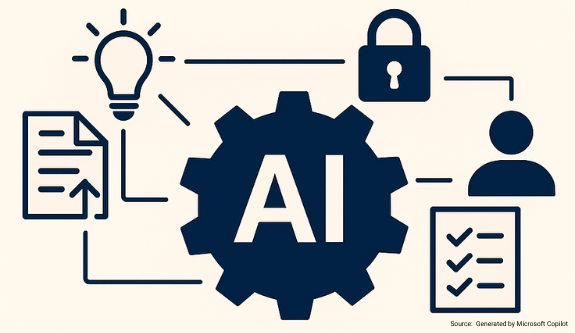
Generative AI has quickly moved from an experimental concept to an everyday business tool. Organizations are adopting it to boost productivity, improve decision‑making, and uncover new insights. However, one important reality is becoming clear: innovation cannot move faster than governance.
As this rapid transformation continues, leaders are being asked to “reflect forward.” In other words, they must respect the foundations of information governance (IG) while rethinking how those principles apply in an AI‑driven world. Generative AI is changing how information is created, shared, and used across the enterprise. As a result, it introduces responsibilities that traditional governance models were not designed to support.
AI‑generated summaries, reports, and insights now function as real organizational information assets. At the same time, data flows are becoming more complex, and decision‑making is increasingly automated. Unfortunately, many existing IG and records and information management (RIM) policies do not fully address machine‑generated content. Therefore, organizations must develop their governance strategies. This development is not meant to slow innovation, but rather to guide it with clarity and purpose.
Principles for AI‑Ready Information Governance
Forward‑thinking organizations are embedding generative AI into their broader strategic planning. By doing so, they ensure governance updates stay aligned with existing RIM policies and digital transformation goals across the whole organization.
As AI reshapes how information is created and is used, core governance principles become even more critical. For example, transparency and explainability help maintain trust by documenting how AI tools work and how they influence decisions. Likewise, data minimization and purpose limitation support responsible data use by reducing unnecessary exposure.
Additionally, strengthened IT security and access controls help protect sensitive information from unintended disclosure. Treating AI‑generated content as part of the information lifecycle is also essential. This means classifying, retaining, and disposing of AI outputs according to established RIM standards. As a result, governance remains consistent even as technology evolves.
Most importantly, human oversight remains essential throughout the entire organization. Clear accountability must be defined for reviewing AI‑assisted outputs, correcting errors, and addressing potential bias. Without this oversight, trust in both the technology and the organization can quickly erode.
Modernizing Governance Without Starting Over
Organizations do not need to rebuild governance programs from scratch. Instead, they can start with a structured organizational assessment of existing policies, standards, and controls to identify gaps, risks, and alignment opportunities, then modernize current governance frameworks through targeted policy updates that address AI‑specific risks, accountability, data management responsibilities, and compliance requirements.
For instance, policies should clearly define acceptable AI use across the organization. They should also address how sensitive data can be safely used in prompts and outputs. In addition, organizations must determine when AI‑generated content becomes an official business record.
Other critical steps include monitoring access to AI tools, establishing ethical and bias‑mitigation standards, and evaluating third‑party AI vendors with the same rigor applied to any other service provider. When these updates are applied thoughtfully, AI adoption stays aligned with organizational values, regulatory requirements, and long‑term strategic objectives. As a result, innovation can progress without compromising the integrity of the information ecosystem.
A Continuous Cycle of Reflection and Adaptation
Generative AI is evolving rapidly, and governance must keep pace. A “reflecting forward” approach encourages organizations to make governance an ongoing discipline rather than a one‑time effort.
This approach includes:
- Reassessing AI tools on a regular basis
- Monitoring regulatory and industry developments
- Auditing AI‑generated content for accuracy and risk
- Updating policies as new risks and opportunities emerge
By continuously revisiting governance practices, organizations remain prepared for change instead of reacting to it.
Governance as a Strategic Enabler
When AI is integrated into strategic planning and aligned with RIM policies, governance becomes a powerful enabler rather than a barrier. By modernizing governance frameworks, organizations can unlock the full potential of generative AI while protecting the security, integrity, and long‑term value of their information.