
By Michelle Miguel on Tuesday, April, 7th, 2026 in Blog Posts,Blog: Records & Information Management (RIM),Latest Updates. No Comments


From Retention Schedule to Information Map
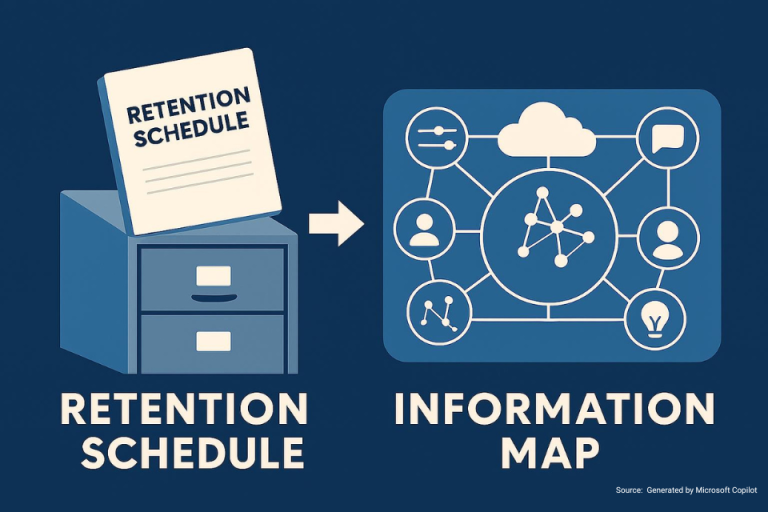
There was a time when information management felt simple. Records lived in file rooms, shared drives, and a small number of well‑managed enterprise systems. Records management programs relied on clearly defined retention schedules, printed, laminated, and stored in binders, that were sufficient to guide the entire organization and support regulatory compliance.
That world is gone.
Today, digital information moves at unprecedented speed across cloud platforms, collaboration tools, and enterprise productivity systems. It multiplies within email and messaging applications, surfaces in content management systems, and increasingly appears in places where no one originally planned AI workspaces, social media platforms, and shadow IT systems. Information is now created by every employee, across distributed environments, in real time, creating new challenges for data governance, records retention, risk management, and compliance.
How do you apply retention rules when information is everywhere?
For Records and Information Management (RIM) professionals, this question defines the challenge of modern governance.
The truth is, you can’t, not with a traditional retention schedule alone. The modern information landscape demands something more dynamic, more visual, and far more connected to the way organizations work. It demands an information map.
When the Map Replaces the Manual
The retention schedule is a policy document. It tells you what to keep and how long to keep it. What it doesn’t do is show you where that information lives, how it moves, or who is responsible for it. It assumes a world where information stays put.
An information map assumes the opposite
It acknowledges the sprawl. It embraces complexity. And then it turns that complexity into clarity. An information map shows the full landscape, systems, repositories, business processes, data owners, and the connections between them. It becomes a living, breathing guide that evolves as the organization evolves. Where the retention schedule provides the rules, the information map provides the reality.
The Journey from Chaos to Clarity
Imagine walking into an organization that has grown fast—too fast. Teams adopted new tools without retiring old ones. Data lives in places no one remembers setting up. The retention schedule is technically “up to date,” but no one can explain how it applies to the dozens of cloud apps employees use every day.
This is where the journey begins.
- Finding the Information You Didn’t Know You Had
The first step is discovery. Not the glamorous kind—more digital archaeology. You uncover forgotten repositories, shadow IT systems, and data stores that have quietly accumulated for years. You talk to business units and learn how they work, not how the process diagrams say they work. Patterns emerge. Categories form. The fog begins to lift. - Connecting Rules to Reality
Once you know where information lives, you can finally connect the dots. That HR retention rule? It applies more than the HRIS—it touches onboarding tools, email threads, shared drives, and workflow apps. The marketing records category? It’s scattered across cloud storage, social media archives, and AI content generators. Suddenly, the retention schedule becomes more than a list. It becomes a set of instructions you can follow. - Drawing the Map
You start mapping systems processes, processes to information types, and information types to retention rules. You identify owners, stewards, and stakeholders. You visualize data flows. You see where risk lies and where opportunities for cleanup and automation lie.
The map becomes a shared language. IT sees the governance picture. Legal sees the risk picture. Business units see their responsibilities. Privacy teams see where sensitive data lives. Everyone sees the same landscape, often for the first time.
Why This Shift Matters More Than Ever
Organizations today face unprecedented pressure:
- Regulations are tightening
- Data volumes are exploding
- AI is generating new content at lightning speed
- Cloud systems evolve faster than policies can keep up
- Legal and privacy risks grow with every unmanaged repository
A retention schedule alone can’t meet these challenges. It’s too static for a world that moves this fast. An information map, however, is built for change. It adapts. It grows. It helps organizations make decisions with confidence instead of guesswork.
For RIM professionals, this shift isn’t just a modernization effort; it’s a transformation of the role itself. It elevates RIM from policy writers to strategic navigators of the information landscape. The Future Belongs to Those Who Can See the Whole Picture. Learn more on this topic at our session at the 2026 NAGARA Conference.